
April and the beginning of May are the main period when maize is sown in agricultural fields. The recommended sowing period generally falls between 15 April and 5 May. Every farmer knows that maize seeds, especially when they begin to swell and germinate, are particularly attractive to wild boars. These animals can travel considerable distances to reach freshly sown maize fields and feed on the seeds. They are capable of causing extensive damage to crops, making wild boar damage a serious problem for farmers. For this reason, farmers often start thinking about how to protect their fields from wild boars even before sowing. Discover proven methods for protecting maize from wild boars. Learn how to reduce crop damage and protect your harvest throughout the growing season! Maize seeds are sometimes treated before sowing in an attempt to discourage pests from eating them, but unfortunately this method is often ineffective against wild boars. Farmers therefore use various methods to deter wild boars from agricultural fields. It is important to remember that wild boars adapt very quickly to changing conditions. They may become accustomed to deterrents and eventually cross the barriers created by them. Wild boar deterrents are available in several forms, including:
- scent-based deterrents,
- sound deterrents,
- electric fences for wild boars.
Post Contents [hide]
- Maize sowing dates and wild boar attacks
-
How to protect maize effectively from wild boars?
- Electric fence for wild boars – effective protection for agricultural fields
- What electric fence should you use for wild boars?
- Scent-based wild boar repellents – how to use them?
- Sound deterrents for wild boars – what are they and how do they work?
- Patrolling fields with people and dogs – natural crop protection
- Wildlife damage to maize crops
- FAQ – Frequently Asked Questions About Protecting Maize from Wild Boars
Maize sowing dates and wild boar attacks
Maize sowing usually takes place around the end of April and beginning of May, although the exact date depends on weather conditions and may also vary between growing regions. The key factor is soil temperature rather than air temperature. Maize seeds germinate best when the soil temperature at a depth of approximately 5 cm reaches between 8 and 12 oC, without the risk of significant night-time temperature drops. Maize is often grown on extensive fields covering large areas, many of which are located alongside forests. Forests provide natural habitats for wild animals, including wild boars. Germinating maize seeds are particularly attractive to these animals. Generally, the closer a field is to woodland, the greater the risk of crop damage. When do wild boars feed in maize fields? One of the highest-risk periods lasts from sowing until the two-leaf stage, approximately until the end of May. During this period, crops require particularly careful monitoring because wild boars can cause irreversible damage and substantial financial losses. Farmers may also avoid growing maize as a long-term monoculture on the same fields. Otherwise, wild boars may learn where maize is regularly planted and return to the same feeding areas year after year.
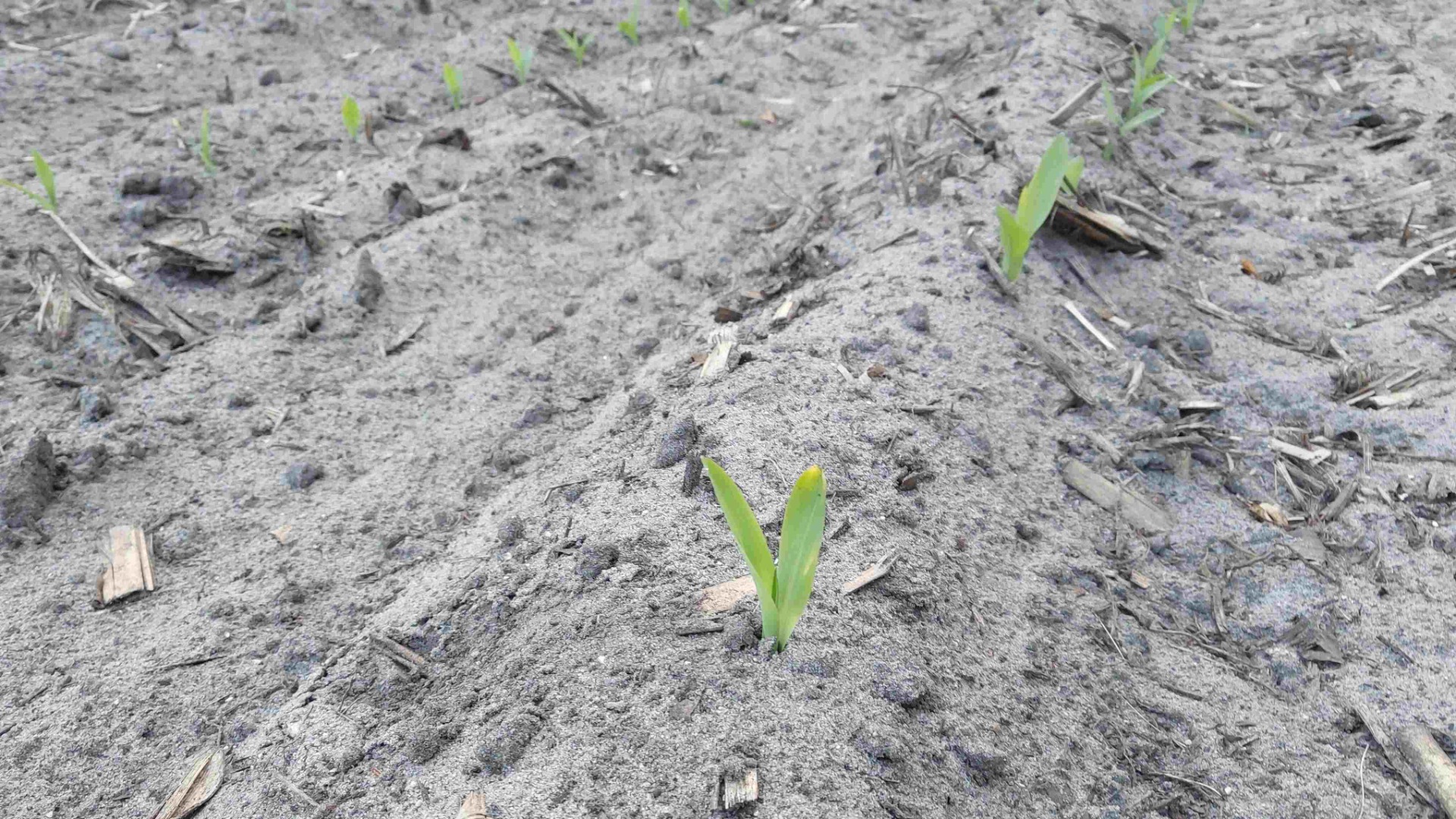
When do wild boars feed in maize fields?
It is sometimes assumed that wild boars cause the greatest damage immediately before harvest, when maize plants are tall and have developed cobs. However, very serious losses can also occur during the earliest stages of plant growth. Wild boars dig up swollen and germinating maize seeds, causing extensive damage across large areas. They may pull emerging plants out together with their roots, leaving them with little chance of becoming established again. Swollen and germinating maize is particularly attractive to wild boars. They also search freshly sown fields for food, digging seeds out and bringing them to the surface. Maize crops remain particularly vulnerable to wild boar attacks until the end of May. Fields located close to woodland are at especially high risk because the animals can reach them easily. A maize field that has been successfully protected during the early growth stages may once again become vulnerable when the cobs begin to ripen, approximately from mid-July until harvest in autumn. During this period, farmers should once again focus on protecting crops from wild boars.
How to protect maize effectively from wild boars?
Maize crops often cover large areas ranging from several to several dozen hectares. Damage caused by wild boars can therefore result in losses worth thousands. Effective protection against wild boars is consequently extremely important. Unfortunately, wild boars adapt quickly to changing conditions and may become accustomed to certain deterrent methods. They are intelligent animals and can remember where maize was planted in previous years and where food can be found. For this reason, no deterrent method can be considered permanently 100% effective in every situation. The most appropriate method depends on the size of the field and the budget available to the farmer. How can wild boars be deterred? The following methods are commonly used to protect maize crops:
- Electric fence for wild boars – an electric fencing system that deters animals by delivering an electrical pulse when they touch the fence conductor,
- Scent-based wild boar repellents – products with an intense odour designed to discourage wild boars from entering the protected area,
- Sound-based wild boar deterrents – devices or other sources of noise intended to discourage animals from approaching the field,
- Field patrols – regularly monitoring crops with people and dogs.
Electric fence for wild boars – effective protection for agricultural fields
An electric fence for wild boars is an effective way to protect an area against unwanted animals, including wild boars, dogs, cats and other wildlife. Because wild boars are strong and energetic animals, all components of the electric fence should be selected appropriately. Steel wire rope for electric fencing is a particularly suitable choice for protecting crops against wild boars because it is strong and provides good electrical conductivity. When a wild boar touches the conductor, it receives an electrical pulse. The pulse is designed to be unpleasant and discourages the animal from attempting to cross the fence. Three levels of steel wire rope are recommended, positioned approximately 25 cm, 45 cm and 75 cm above the ground. Wild boars have very sensitive snouts, which they use to investigate their surroundings. The snout is therefore often the first part of the animal to come into contact with an electric fence conductor. Contact with the fence discourages animals from making further attempts to cross the boundary, and they learn to avoid the protected area. It is important not to leave gaps in the fence, as wild boars can quickly find them and use them to enter the protected field. Vegetation growing underneath the fence can also touch the conductors and reduce the strength of the electrical pulse, so grass and weeds should be cut regularly. Choosing suitable fence posts is another important aspect of installation. Wooden posts should be installed at corners, gateways and approximately every 50 metres along straight sections to reinforce the fence. Between them, polypropylene or fibreglass electric fence posts can be installed approximately every 6–10 metres.
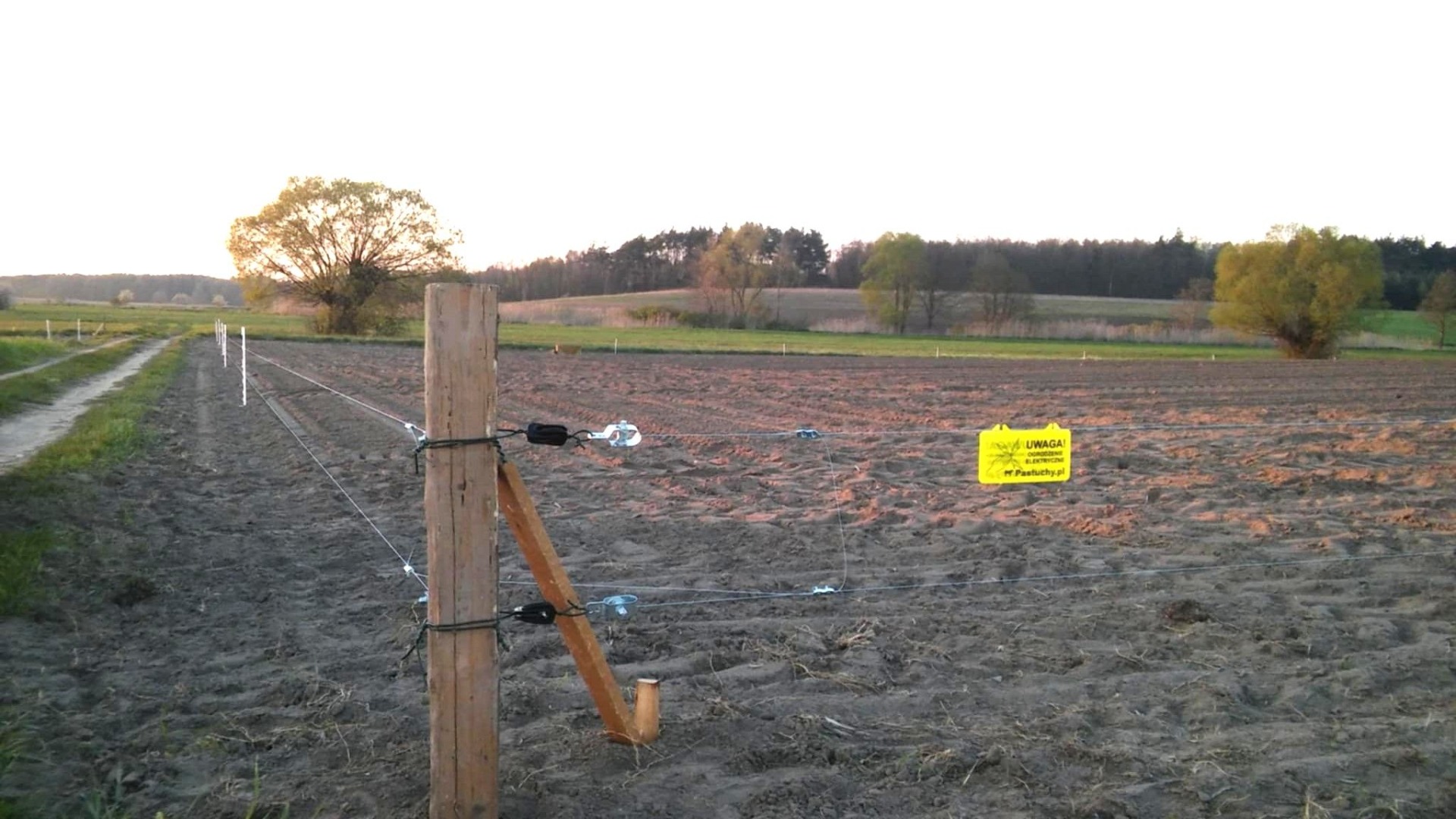
What electric fence should you use for wild boars?
The electric fence energizer is the most important component of an electric fence for wild boars. When choosing an energizer, particular attention should be paid to pulse energy and voltage. For wild boars, the minimum recommended parameters are approximately 3,000 mJ (3 J) of pulse energy and 10,000 V. Large agricultural fields are often located in areas without access to mains electricity. Fortunately, electric fences for wild boars can be powered either by batteries or from a 230 V mains supply, giving farmers a choice depending on local conditions. An electric fence energizer has two connections – the fence output (+) and the earth connection (-), which is connected to an earth rod driven into the ground. When an animal standing on the ground comes into contact with the electrified conductor, the circuit is completed and the animal receives an electrical pulse. A battery-powered electric fence energizer can also be supported by a solar panel. The solar panel uses sunlight to recharge the battery, which in turn powers the electric fence for wild boars. A properly selected energizer, combined with a correctly installed and maintained fence, can provide highly effective protection against wild boars.
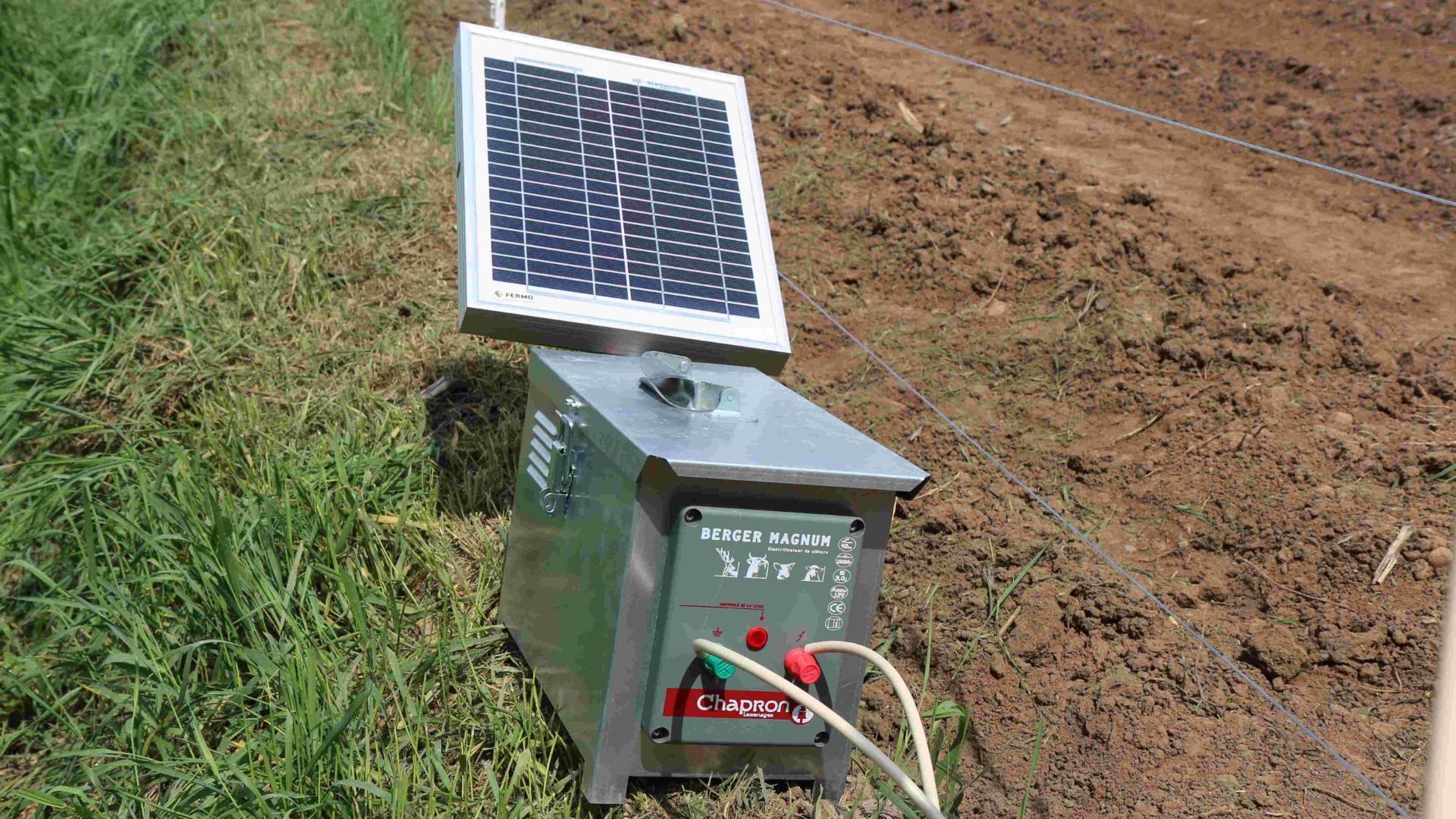
Scent-based wild boar repellents – how to use them?
Scent-based wild boar repellents are another method used to protect crops from damage. They create an odour barrier intended to discourage wild boars from entering a protected area. Scent-based wildlife repellents may imitate or use odours associated with humans or dogs. Hukinol is a strong-smelling wildlife repellent used to deter wild boars and other animals. It contains concentrated 3-methylbutanoic acid, also known as isovaleric acid, which produces an intense and characteristic odour. The liquid is applied to absorbent carriers such as cotton pads, gauze or sponges. These carriers are then placed in dispensers and positioned on posts along the edge of the field to create a scent barrier. Dispensers containing the repellent are generally positioned approximately 10–20 metres apart. How long does Hukinol last? Its effective duration depends on weather conditions, but one application generally lasts approximately 2–3 weeks. Special dispensers containing an impregnated absorbent material can help extend the period of action. Another scent-based product associated with wild boars is beechwood tar, a dark liquid produced through the dry distillation of beech wood. Beechwood tar has a strong, characteristic smell and can be applied to wooden posts or nearby trees. Dog hair and human hair may also be used to create scent barriers. Scent-based wild boar deterrents can be useful, although their relatively short duration is one of the main disadvantages of this method.
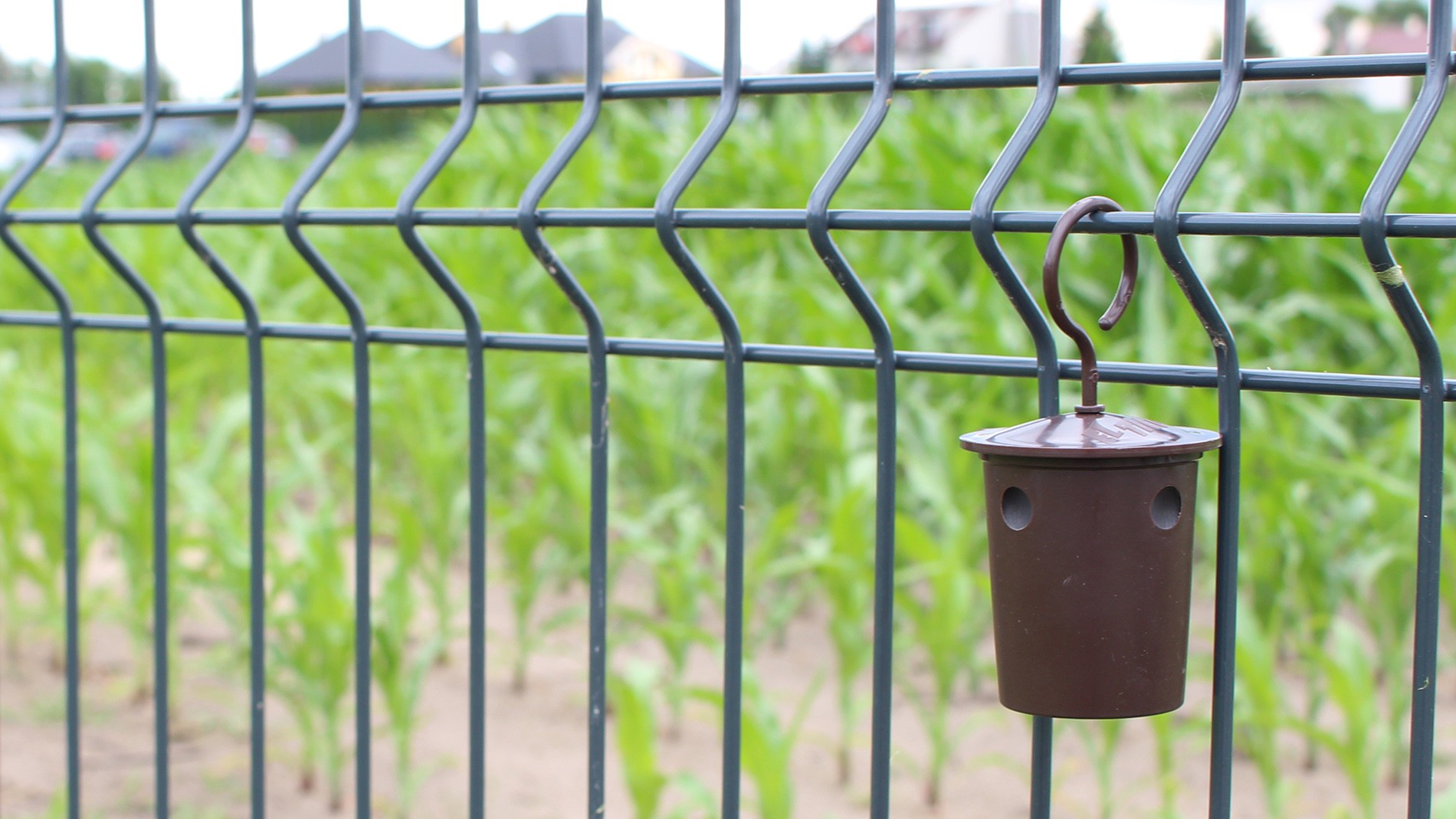
Sound deterrents for wild boars – what are they and how do they work?
A sound-based wild boar deterrent is a device or system designed to emit sounds that discourage wild animals from entering a protected area. Some devices use high-frequency or ultrasonic sounds that may be outside the normal range of human hearing. These systems are used to protect agricultural fields by creating an uncomfortable acoustic environment for wildlife. A frequency of approximately 22 kHz may be used by some devices intended for wild boars. Varying the frequency can help reduce the risk of animals becoming accustomed to a constant sound. The location of the device is particularly important because ultrasonic wild boar deterrents work best in relatively open areas. Trees, buildings and other obstacles can interfere with the propagation of sound. A sound deterrent for wild boars may be powered from a 230 V mains supply or a 12 V battery, allowing it to be used in areas without access to the electrical grid. Flashing lights may also be used during the evening and at night as an additional deterrent.
Patrolling fields with people and dogs – natural crop protection
Wild boars can be wary animals, particularly when they detect the presence or scent of people and dogs. Regular patrols by people and dogs can therefore be used as an additional method of protecting maize crops. Because wild boars are particularly active during the evening, night and early morning, field inspections are often carried out during these periods. Tractors or quad bikes can be used to patrol large fields more quickly. This method has both advantages and disadvantages. One advantage is that it does not require specialist deterrent equipment. It is also a non-chemical method of crop protection. Herding, hunting and guard dog breeds may be particularly suitable for monitoring fields. Dogs also leave scent marks, including urine, which can contribute to the presence of an odour associated with a potential threat. The main disadvantage is the amount of time required to patrol large areas regularly. Wild boars may eventually begin to avoid frequently patrolled fields and move to other areas.
Wildlife damage to maize crops
Wildlife damage refers to material losses caused by wild animals to agricultural crops, horticultural crops and forests. Maize is among the crops particularly vulnerable to damage caused by wild boars. A group of wild boars can damage a substantial area of a maize field during a single night. Under Polish hunting law (Journal of Laws 1995 No. 147, item 713, as amended), responsibility for certain types of damage caused by game animals to crops and agricultural produce lies with the leaseholders or managers of hunting districts, which in practice are often hunting associations. Farmers are responsible for reporting wildlife damage. The next stage involves assessing the damage by the appropriate commission, after which compensation may be paid by the relevant hunting association. Hunting associations may also provide farmers with measures designed to protect crops against wild boars in order to reduce the extent of damage and the resulting compensation costs.
FAQ – Frequently Asked Questions About Protecting Maize from Wild Boars
When should wild boars be deterred?
The key periods are immediately after sowing and when the maize reaches the milk stage. Wild boars are particularly interested in fields just after sowing, when they dig up and eat the seeds, and later when the maize cobs become soft and sweet.
How can you keep wild boars out of maize fields?
One of the most effective solutions is a powerful electric fence with an energizer of more than 3 J. It can also be combined with scent-based repellents such as Hukinol to provide additional protection.
How do you build an electric fence for wild boars?
Install two or three rows of wire or steel wire rope at approximately 20 cm, 40 cm and, where required, 70 cm above the ground. A powerful energizer and effective earthing are essential. Regularly cut grass and other vegetation underneath the conductors to prevent energy losses.
What electric fence energizer should you use for wild boars?
The electric fence energizer is the heart of the system. For wild boars, an energizer with a pulse energy of approximately 3–6 J is recommended. Wild boars have thick bristles and a layer of body fat, so a sufficiently powerful energizer is particularly important.
How do you use Hukinol?
Apply a few drops of Hukinol to pieces of cloth, cotton pads or other absorbent material. Place them inside suitable dispensers and attach them to posts approximately 50–100 cm above the ground. Position the posts approximately every 10–20 metres around the area you want to protect. Do not pour Hukinol directly onto the soil or plants.
How do you remove the smell of Hukinol?
If Hukinol gets onto your hands or clothing, a solution of vinegar and baking soda can be used to help remove the strong odour.
How long does Hukinol last?
A single application of Hukinol generally remains effective for approximately 2–4 weeks, depending on weather conditions.