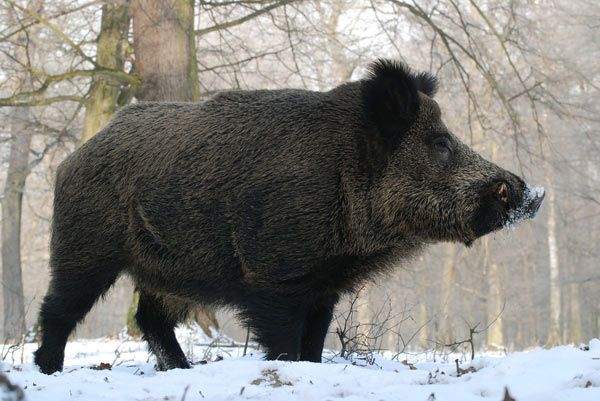
The long-standing problem faced by many hunting clubs and farmers is game damage caused by wild animals. The animals responsible for the most extensive crop losses are wild boars. Their population in Poland is currently estimated at around 270,000. Moving in groups, wild boars can destroy a large part of maize fields and root crops, including potatoes, in just one night.
According to the Polish Hunting Law Act of 13 October 1995 [Journal of Laws 05.127.1066, as amended], responsibility for such damage lies with the hunters leasing the hunting grounds, i.e. directly with the hunting clubs. On this basis, they are obliged to compensate farmers for the losses incurred. However, financial compensation does not fully reflect the amount of work and effort invested in crop production. In addition, compensation payments can place a significant burden on hunting club budgets. For this reason, one of the most effective and economically beneficial ways to protect crops, pastures and other green areas against wildlife damage is to use an appropriate protective system, namely an electric fence.
Selecting the right to provide maximum protection for a plantation is not always simple. Various devices designed to prevent game damage are available on the market. When selecting the complete system, particular attention should be paid to the power of the . According to the recommendations in this article, it should provide at least 3000 mJ of impulse energy and a voltage of no less than 10,000 V. Such parameters can provide effective crop protection even on very long fence lines.
Power is particularly important because wild boars have thick bristles, which reduce their sensitivity to weak electric impulses. A high-powered effectively discourages animals from entering protected fields, as any attempt to cross the fence results in a short electrical impulse. In practice, battery-powered energizers or solar energizers are particularly convenient because protected fields are often located near forests, where access to mains electricity is unavailable.
Choosing suitable is also important for effective protection against wildlife damage. Due to their high strength and flexibility, fibreglass posts are particularly recommended. Standard can also be used successfully. Depending on the type of post, different types of insulators are available. High-quality insulators help protect the fence against electrical leakage and faults.
When designing an electric fence line to protect crops against wild boars, it is important to position the at the correct height. Galvanised steel wire ropes are particularly suitable for protecting fields against wild boars because of their high breaking strength. Compared with wire of the same cross-section, their resistance to breaking may be significantly higher.
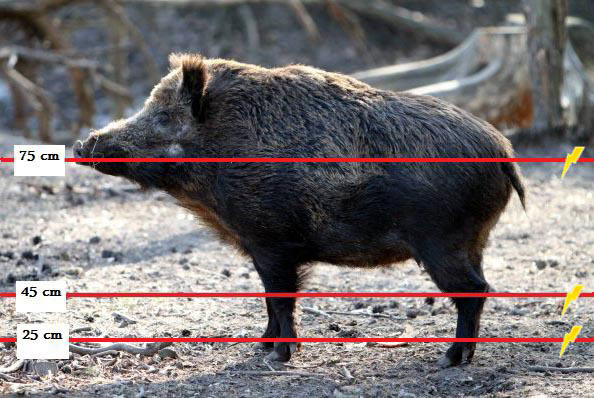
It is recommended to use two conductors. The first should be positioned approximately 40–45 cm above the ground, while the second should be installed at around 70–75 cm. This arrangement greatly reduces the risk of wild boars forcing their way through the fence. An additional third conductor can be installed at a height of approximately 25 cm in areas with uneven or undulating ground. The steel wire can be tensioned easily using a special wire tensioner and tensioner handle.