Protecting crops from wild animals is one of the main objectives of proper game management. The extensive damage caused by animals such as deer on agricultural land often leads to disputes between farmers and hunting clubs. In Poland, compensation for game damage is regulated by the Hunting Law Act of 13 October 1995 [Journal of Laws 2005 No. 127 item 1066, as amended]. Under these regulations, hunting clubs leasing hunting grounds may be responsible for compensating farmers for certain types of damage. However, compensation payments can place a significant burden on hunting club budgets. Traditional fences are often ineffective against deer, as these animals are capable of overcoming many physical barriers. For this reason, one of the most effective ways to protect crops is to invest in a suitable .
An should be based on a powerful – with an impulse energy of at least 3000 mJ and a fence voltage of approximately 8,000 V. Such a device generates regular electrical impulses with sufficient energy to effectively discourage animals from entering the protected area. operating at 220–240 V are generally very efficient. However, because fields and plantations are often located next to forests and far away from a mains power supply, battery-powered energizers and solar energizers are usually the most practical choice. Although they require slightly more attention than mains-powered models, they can provide equally effective protection.
When constructing , it is important to remember that the fence should create both a physical and psychological barrier. After coming into contact with a properly energised fence, the animal receives a short but unpleasant electrical impulse, which discourages it from attempting to enter the protected area again. Bait is sometimes placed on an electric fence to encourage deer to investigate it. Due to their sensitive sense of smell, the animals may approach and touch the fence with their nose or tongue. The unpleasant impulse helps them associate the fence with danger and encourages them to avoid the protected area in the future.
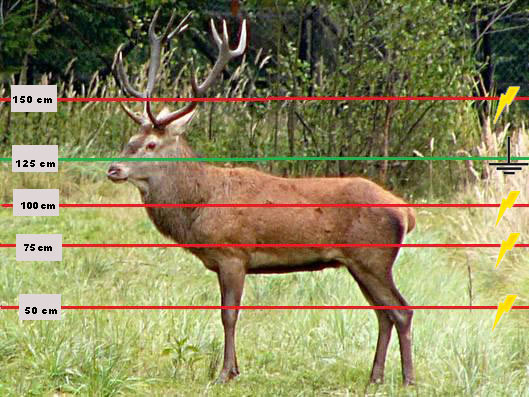
The highest electric fence line for deer should be positioned at approximately 150 cm above the ground. Additional conductors can be installed at 100, 75 and 50 cm, with another line at approximately 125 cm where required to provide additional protection. It is recommended to use steel wire rope or wire. A highly visible electric fence tape can be used at the level most visible to the animals. When constructing an electric fence to prevent wildlife damage, plastic fence posts or can be used. Vegetation growing around the conductors should also be regularly controlled, as contact with grass, weeds or branches can reduce the effectiveness of an electric fence.