
Poultry red mite (Dermanyssus gallinae), sometimes informally referred to as a chicken flea, is a troublesome blood-feeding parasite of birds. These mites have an oval body, four pairs of legs and may appear red after feeding. During the day, poultry red mites usually hide in cracks and crevices, while at night they become active and attack birds. Poultry red mites can affect chickens at every stage of life, from young chicks to adult birds.
Bites and repeated blood feeding cause stress, restlessness and sleep disturbance in affected birds. In laying hens, infestations can lead to a drop in egg production. Poultry red mites may also weaken the birds, reduce their resistance and contribute to the spread of dangerous pathogens and poultry diseases. Severe infestations can lead to significant losses in the flock, particularly among young or weakened birds.
Poultry red mites are difficult to control because they spend much of their time hidden away from the host. They can also survive for many months without feeding, including under relatively low-temperature conditions, which makes complete elimination from poultry houses especially challenging.
When controlling poultry red mite (Dermanyssus gallinae), prevention and regular treatment are extremely important. All control measures should be carried out at the right time and repeated systematically. To control poultry red mites effectively, it is worth understanding the different stages of their development. Their life cycle depends largely on temperature and humidity. At an optimal temperature of around 20–30°C, the full development cycle may take approximately one week, which means that a poultry house can become heavily infested in a very short time.
Female poultry red mites lay eggs in cracks and crevices where they hide during the day. After approximately 2–3 days, larvae hatch from the eggs. At this stage, they are not yet able to feed on birds. The larvae develop further within around 24–48 hours and then become capable of feeding on chickens. After several more days, the mites reach the adult stage and are able to reproduce. This short development cycle means that poultry red mite populations can increase very rapidly. For this reason, control measures should be started as soon as the first signs of infestation are noticed.
Understanding the different stages of the mite’s life cycle is essential for effective control. Treatments should be repeated at intervals of approximately 4–5 days in order to target mites that were still in the larval or developing stages during the previous treatment. Only regular and correctly timed control measures can help eliminate poultry red mite infestations in chickens.

Home remedies for poultry lice
Poultry red mite control. Home remedies for controlling red mites are primarily physical methods. Before taking action to eliminate the parasites, the animals should be moved to another room. Red mite control should begin with thoroughly cleaning the room and starting the coop disinfection process. Litter and feed residues that may harbor parasites must be removed from the hen house. Next, the entire room, as well as feeders and drinkers, must be thoroughly washed. Particular attention should be paid to all the nooks and crannies where the poultry red mite lives.
Unfortunately, physical methods will not completely solve the problem. Even a very thorough disinfection of hen houses will not make the red mite disappear completely. Controlling them with home remedies will only yield a partial effect. Therefore, home remedies for deworming chickens are not fully effective—disinfecting the backyard coop is much more effective.
It is often necessary to use additional products. It is worth using powders such as diatomaceous earth for preventive purposes. However, chemical methods, i.e., using sprays that eliminate parasites, are the most effective. So, how do you control fleas in the chicken coop? There are preparations available that can be applied not only to surfaces but also directly onto the birds. Bedbug control requires patience, as this parasite is very difficult to eliminate. A complete set for controlling red mites effectively repels bedbugs by using products both inside the coop and by strengthening the birds from within. One effective method of fighting red mites is the preparation Exzolt, which is administered in the chickens' drinking water.
It has also been observed that cannibalism among chickens increases during a red mite infestation. So, are there home remedies for cannibalism in chickens? To eliminate cannibalism in chickens, you must first understand its cause.
In red mite control, inspecting equipment and new poultry being introduced to the flock is also very important. It is worth checking carefully whether new birds carry parasites. The same applies to cages, egg trays, and other equipment. Always make sure to thoroughly check if there are red mites on the surface. In the case of new young birds, it is worth giving them a dry bath in diatomaceous earth before adding them to the flock, which will reduce the risk of transferring the poultry red mite.
Natural remedies for red mites
A popular agent for combating red mites is diatomite, also known as diatomaceous earth. It is a powder applied to litter, roosts, crevices, and used for birds' dry dust baths (it can also be applied directly onto their skin). The dust is non-toxic to humans and animals, though inhalation should be avoided as it can irritate the respiratory system. However, it poses a major threat to parasites by absorbing the protective oils from their exoskeletons, causing them to rapidly dehydrate and die.
Natural remedies will only work for minor parasite infestations. In coops heavily infested with parasites, it will be necessary to use acaricides. These are chemical products containing an active substance that paralyzes the parasite and leads to its death. There are also preparations that do not contain an active substance. So, what should you spray the chicken coop with? A spray performed with such a product creates a sticky trap that effectively immobilizes the poultry red mite.
Thermal red mite control
The thermal method involves creating high temperatures in the chicken coop to limit the development of the red mite. The thermal method is characterized by high effectiveness, as it also destroys red mite larvae. However, thermal parasite control is quite difficult to carry out. To achieve the desired effect, high temperatures must be maintained in the room, or hot steam must be generated for 48 hours. Controlling mites with the thermal method is effective; however, individuals without experience in using this technique should not attempt it on their own. The thermal method carries a risk of fire.
Does vinegar work against red mites?
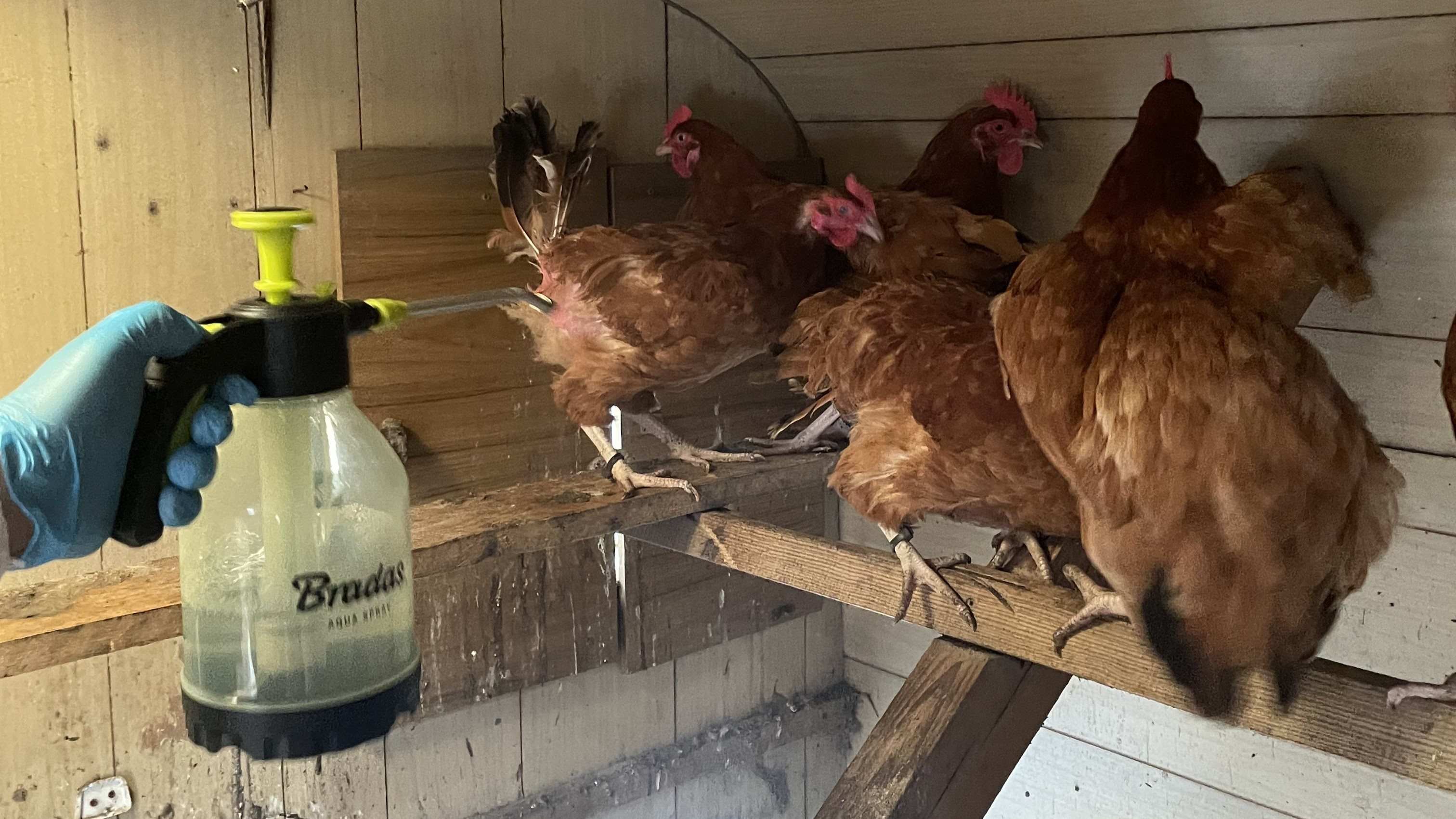
Are there home remedies for treating chickens? Wondering if disinfecting the chicken coop with vinegar will work? Vinegar has a strong, distinctive smell that is unpleasant to parasites such as the poultry red mite. The smell of vinegar can only reduce the activity of chicken lice, but it does not have insecticidal properties. Using vinegar may help in controlling red mites, but it will not eliminate them completely. The poultry red mite is a parasite resistant to many adverse factors, making it hard to eradicate. Using simple home remedies, such as apple cider vinegar, will unfortunately not bring the expected result. The only effective method in controlling red mites is using specialized products designed for this purpose according to instructions.
Lime in litter – effects and operation
Using lime in poultry litter primarily has a virucidal and bactericidal effect. Lime can be spread on the floor before adding fresh bedding to help increase the absorbency of the litter and improve the overall environment inside the poultry house.
Today, lime is used less frequently for this purpose, as poultry keepers more often choose dry disinfection products. Using lime in the bedding is not an effective method of eliminating poultry red mite (Dermanyssus gallinae).
However, lime can be useful for whitewashing walls. Lime helps seal small cracks and crevices that may serve as hiding places for poultry red mites. When controlling a red mite infestation, whitewashing the walls of the chicken coop with lime can help eliminate potential harbourage areas and make it more difficult for the parasites to hide.
Not sure whether your chicken coop is infested with poultry red mites? Read our article: How to Detect Poultry Red Mites and Get Rid of Them.
