
Poultry farming is a continuous process of optimisation aimed at making production as efficient as possible. Whether we keep broilers, turkeys or ducks for fattening, feed is one of the main components of production costs. It is therefore no surprise that every poultry farmer is interested in solutions that can reduce feed consumption. Replacing part of the compound feed with wheat, which is significantly cheaper, offers a reliable way to reduce production costs. For this reason, installing a grain dosing system and supplying birds with cheaper grain mixed with compound feed can be a highly effective solution. However, wheat dosing is not only about cutting costs – it also offers a number of other benefits, which we will discuss in this article.
Post Contents [hide]
Benefits of mixing wheat with poultry feed
- Lower poultry feeding costs. Grain can be added to feed for all poultry species, especially broilers and turkeys.
- Depending on market conditions, wheat may cost around half as much as a standard complete feed mixture. In practical terms, depending on the selected dosing rate, using a grain doser can reduce feeding costs by as much as 20%.
How does adding wheat to poultry feed affect birds?
Mixing grain with compound feed directly in the feeding system is a practical way to introduce whole wheat into the ration. When used as part of a properly designed feeding programme, it can have a positive effect on broilers and turkeys.
In poultry fed using a wheat inclusion programme, the following effects may be observed:
- Whole wheat grains can support the digestive function of chickens and turkeys.
- The presence of whole grains can help support stable conditions in the digestive tract and improve overall feed utilisation.
- The need to grind and digest whole grains stimulates gizzard activity. During the fattening period, a well-developed gizzard can work more efficiently.
- A longer digestion process may contribute to better overall utilisation of feed by birds.
- Improved digestion can also have a positive effect on the consistency and composition of droppings, which may improve litter quality and reduce the need for additional bedding and ventilation.
How to mix wheat with poultry feed?
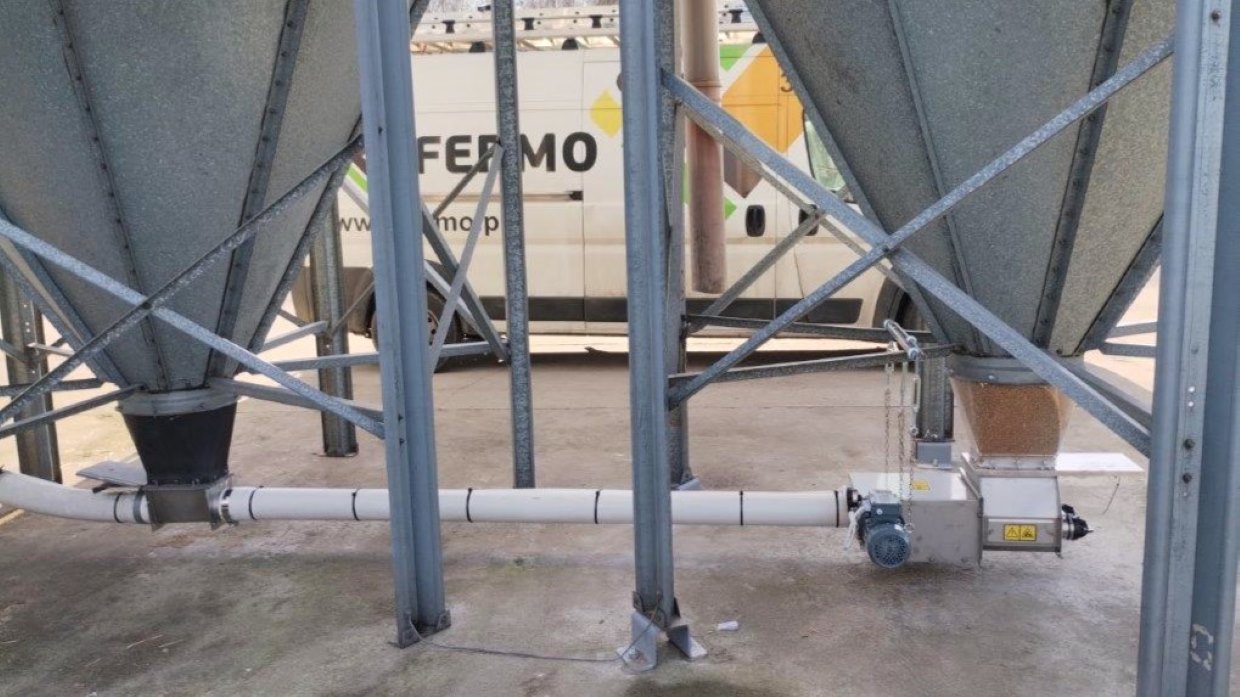
To ensure that grain dosing is accurate and reliable, an appropriate grain doser for poultry feed should be used. The unit must be compatible with the feeding system installed in the poultry house. To minimise dosing errors, grain should be stored in a separate silo and added continuously to pelleted or mash feed directly in the feed conveying system.
Mixing grain into compound feed earlier, for example in a feed mill or feed wagon, may result in inaccuracies. During transport or when filling the silo, grain and feed may separate, causing the final mixture to become uneven.
Every poultry farmer knows that feeding errors can be costly and difficult to correct. For this reason, the grain doser should provide a reliable and precise quantity of grain. The actual mixing process should take place outside the silo, while the feed is being transported through the feed line to the poultry house. Spiral feeding systems have an important advantage in this application because the rotating auger thoroughly mixes the added grain with the complete feed while transporting it.
Can a grain silo also be used as a feed silo?
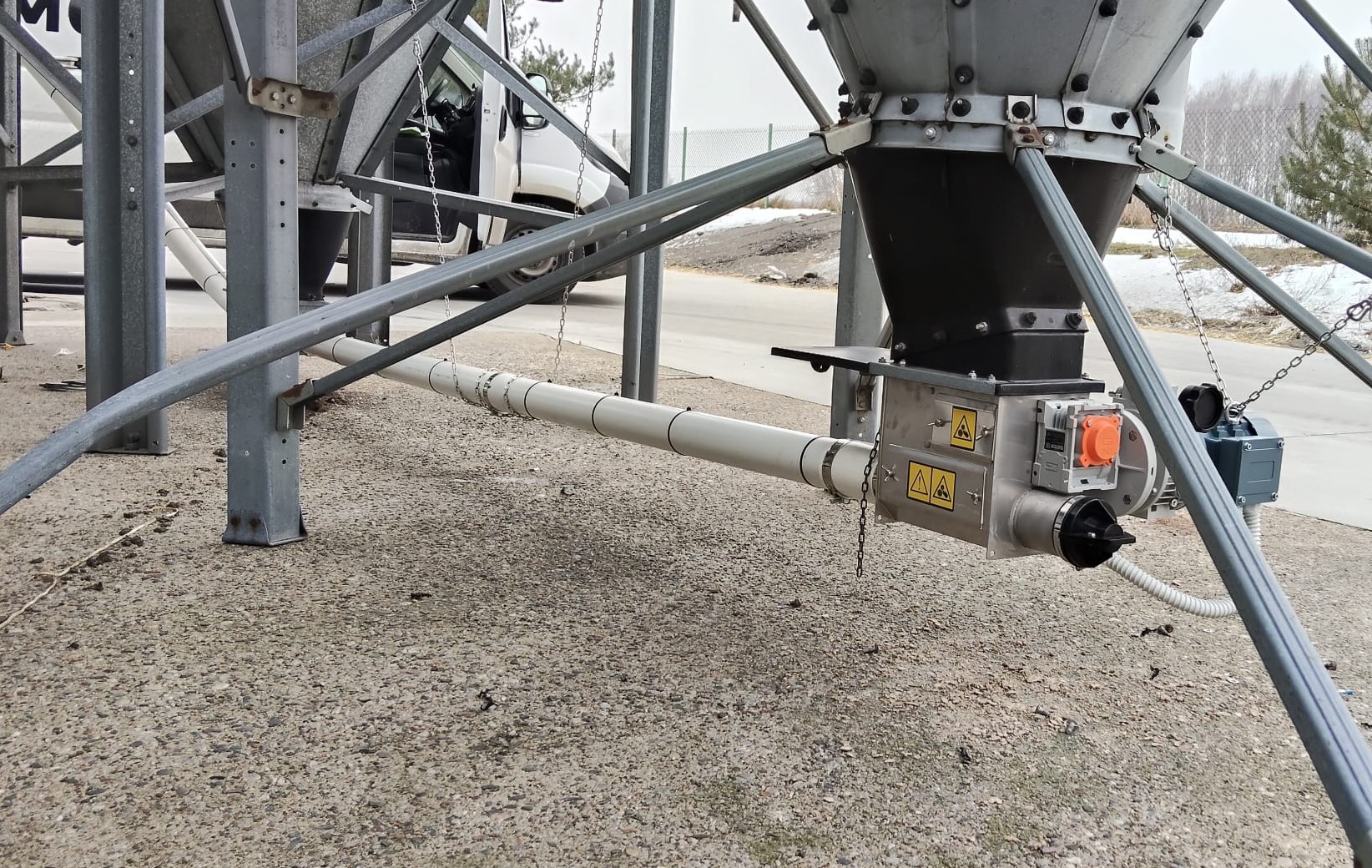
Yes. With a correctly selected dosing system, a grain silo can also be used as a feed storage silo and vice versa. Depending on the production stage, the silo can therefore be filled either with grain or compound feed. F-SMART and F-KOM dosing systems are particularly well suited to this type of installation.
How accurate is grain dosing?
Dosing accuracy depends mainly on the bulk density of the ingredients. It is important to remember that the doser operates on the basis of volumetric proportions. In simple terms, a 30% dosing setting means that the doser prepares a mixture consisting, by volume rather than by weight, of 30% grain and 70% feed. For example, it mixes 30 litres of wheat with 70 litres of compound feed.
One cubic metre of wheat does not weigh the same as one cubic metre of poultry feed. Likewise, one cubic metre of broiler starter feed may have a different weight from one cubic metre of mash feed for commercial laying hens. This difference should always be taken into account when setting and calibrating the dosing system.
How is a wheat grain doser powered and controlled?
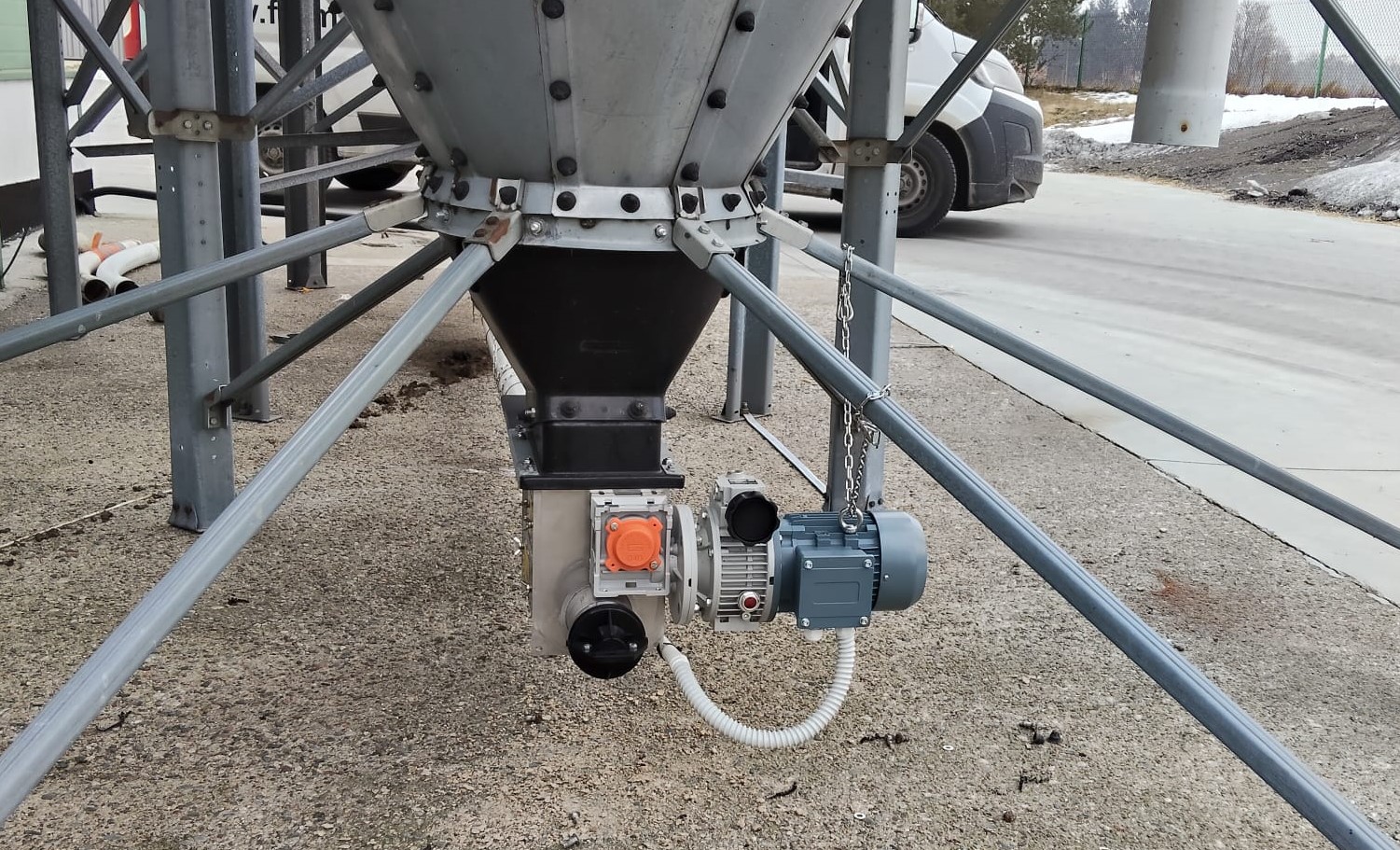
The grain doser is powered by a suitably rated three-phase motor. Its operation should be synchronised with the contactor of the cross feed conveyor. When choosing a dosing system, the type of control must also be selected. Depending on the control version, the grain feeder will offer different dosing ranges and adjustment options. The wheat-to-feed mixing ratio can be controlled in three main ways, which are described below.
Types of dosing control
- Manual Control – this is the simplest form of dosing. In the F-SMART version, the setting is adjusted using the silo slide gate, while in other models the doser operates according to a basic reference setting. This solution offers relatively low dosing precision but does not require an additional control module. It is recommended only for installations where precise dosing is not essential. It is not recommended for intensive broiler or turkey fattening programmes.
- Analogue Control – Recommended Solution! This is a simple and reliable method of adjusting the dosing rate. It offers good accuracy and is easy to calibrate. The required setting is adjusted using a dedicated control knob located near the dosing motor.
- Digital Control – this solution requires greater familiarity with control equipment but provides extensive dosing options and convenient adjustment from a control panel. It can communicate with Fermo F-PRO controllers and can allow remote adjustment of the dosing rate via the Internet. The control system is based on a frequency inverter, which requires appropriate suppression of electrical interference and correct installation practices. Otherwise, interference may affect other equipment, such as capacitive feed sensors installed in control pans.
How does a grain doser for poultry feed work?
The wheat doser supplies a preset percentage of grain directly into the feed pipe. It is important that grain dosing takes place at the beginning of the feeding system. First, the required amount of grain is introduced into the pipe of the spiral conveyor. The cross feed line is then topped up with pelleted or mash feed until full capacity is reached. The mixture is transported by the spiral auger and arrives thoroughly mixed in the hopper of the longitudinal feeding line inside the poultry house.
Which grain doser should you choose?
When selecting a suitable dosing unit, one of the most important parameters is the available dosing range. The correct model should be selected according to the wheat feeding programme used on the farm. As a general guideline, broiler production typically requires a dosing range of approximately 7–30%, while turkey production may require approximately 10–50%. The most popular and user-friendly option is the basic analogue control module.
See our range of grain dosing systems
How to install a wheat grain doser?
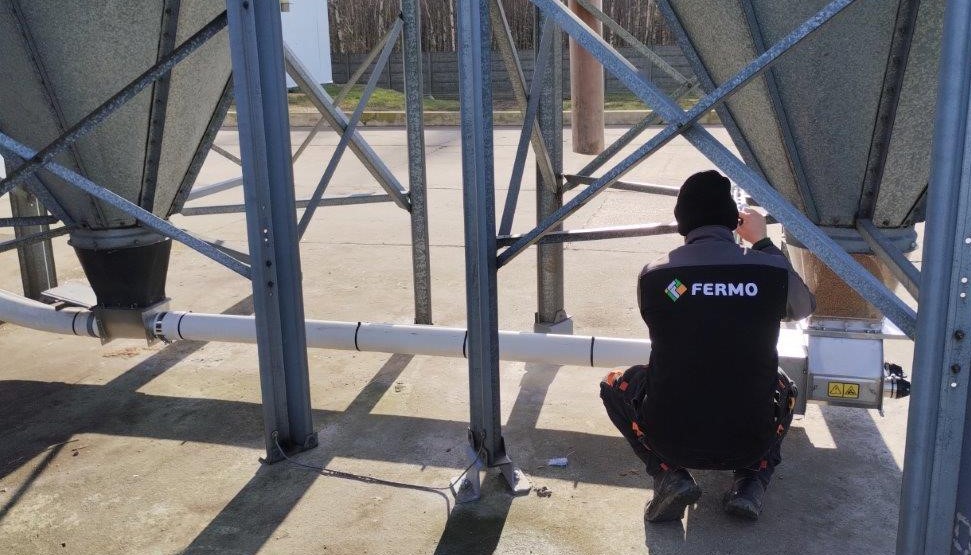
Installing the device is relatively straightforward and depends on the type of feed system already in use and on the selected doser model. In most cases, installing the doser is less complicated than installing the feeding system itself. If there is any doubt about installation skills or experience, professional installation is recommended.
The wheat grain doser should be installed directly under the silo or in another easily accessible location that allows convenient operation and maintenance.
For self-installation, we particularly recommend F-SMART dosing units with analogue control. This solution combines three important advantages: economical operation, easy installation and precise dosing adjustment using a simple control knob.
Do I need an additional silo for wheat?
To dose grain into compound feed, at least two separate storage units are required. One silo is used for compound feed and the second for grain. Alternatively, the grain silo can be replaced with a smaller hopper or storage bin that is refilled regularly. In this configuration, one silo and one hopper may be sufficient.
Depending on the selected dosing system, the grain silo can also be used interchangeably. During the initial production stage it can serve as a feed silo, and later it can be used as a wheat storage silo.
How much wheat can be added to poultry feed?
Depending on the feeding programme and the composition of the supplied compound feed, poultry farmers typically add around 5–30% wheat in broiler production and around 10–50% in turkey fattening programmes.
When introducing grain dosing, it is advisable to proceed gradually and carefully. The feeding programme should be agreed with the veterinarian responsible for the farm and with a poultry nutrition specialist or feed supplier. Once sufficient experience has been gained and production results are monitored, the proportion of grain can be adjusted according to the needs of the flock.
Fermo Grain Dosers – Summary
Our grain dosing systems are used on many poultry farms in Poland and abroad. Years of experience have allowed us to develop a range of dosing units suitable for different poultry production systems. We can also design and manufacture customised installations according to individual requirements.
Fermo grain dosers can be connected in cascade, in parallel or in other configurations. Different types of grain can be introduced into different feed mixtures at selected dosing rates and integrated with various feeding systems. We have also completed multi-stage dosing installations where mash feed, bran and oats were mixed with a high level of accuracy within a single feeding system.